01 · Control room
Dashboard
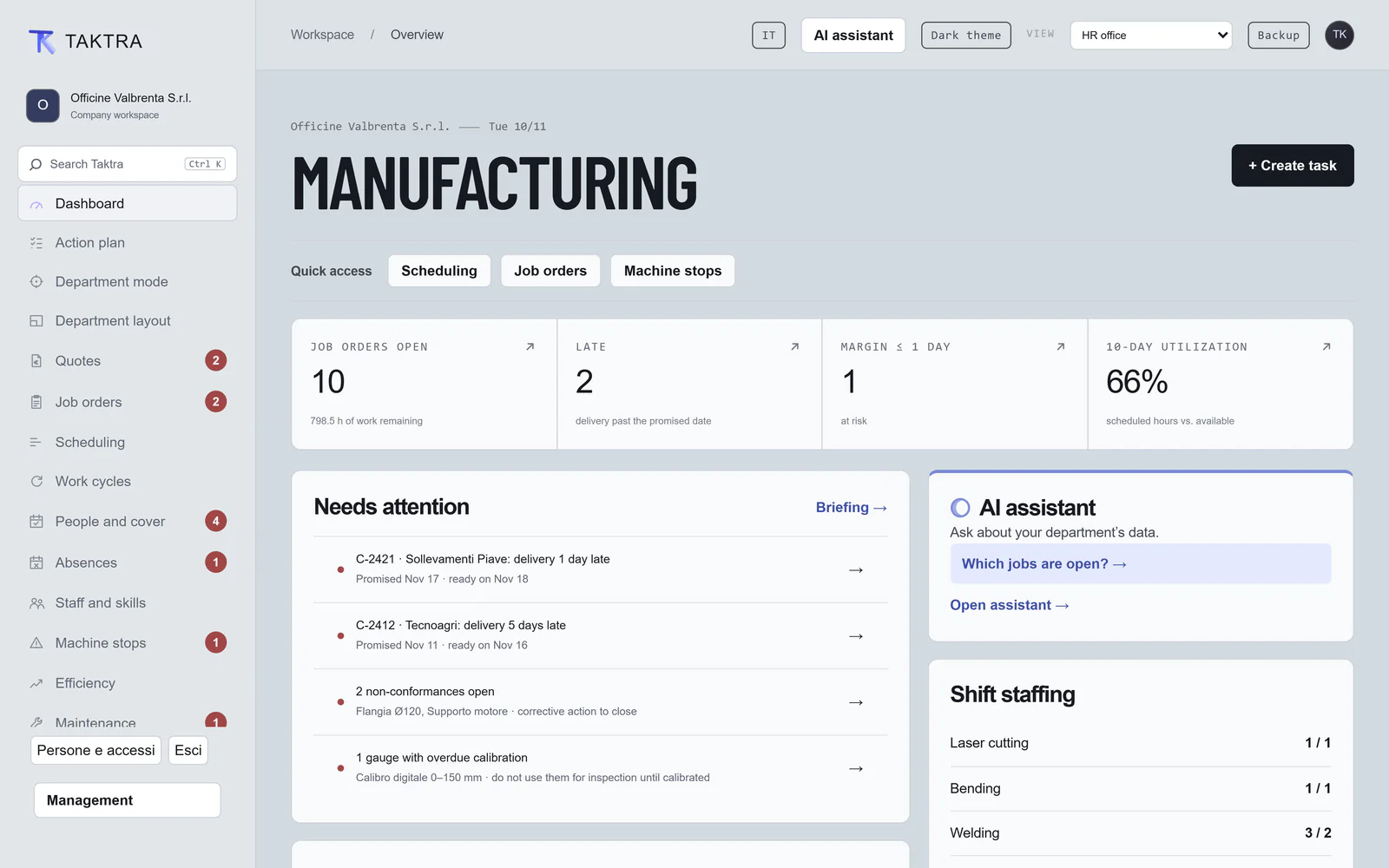
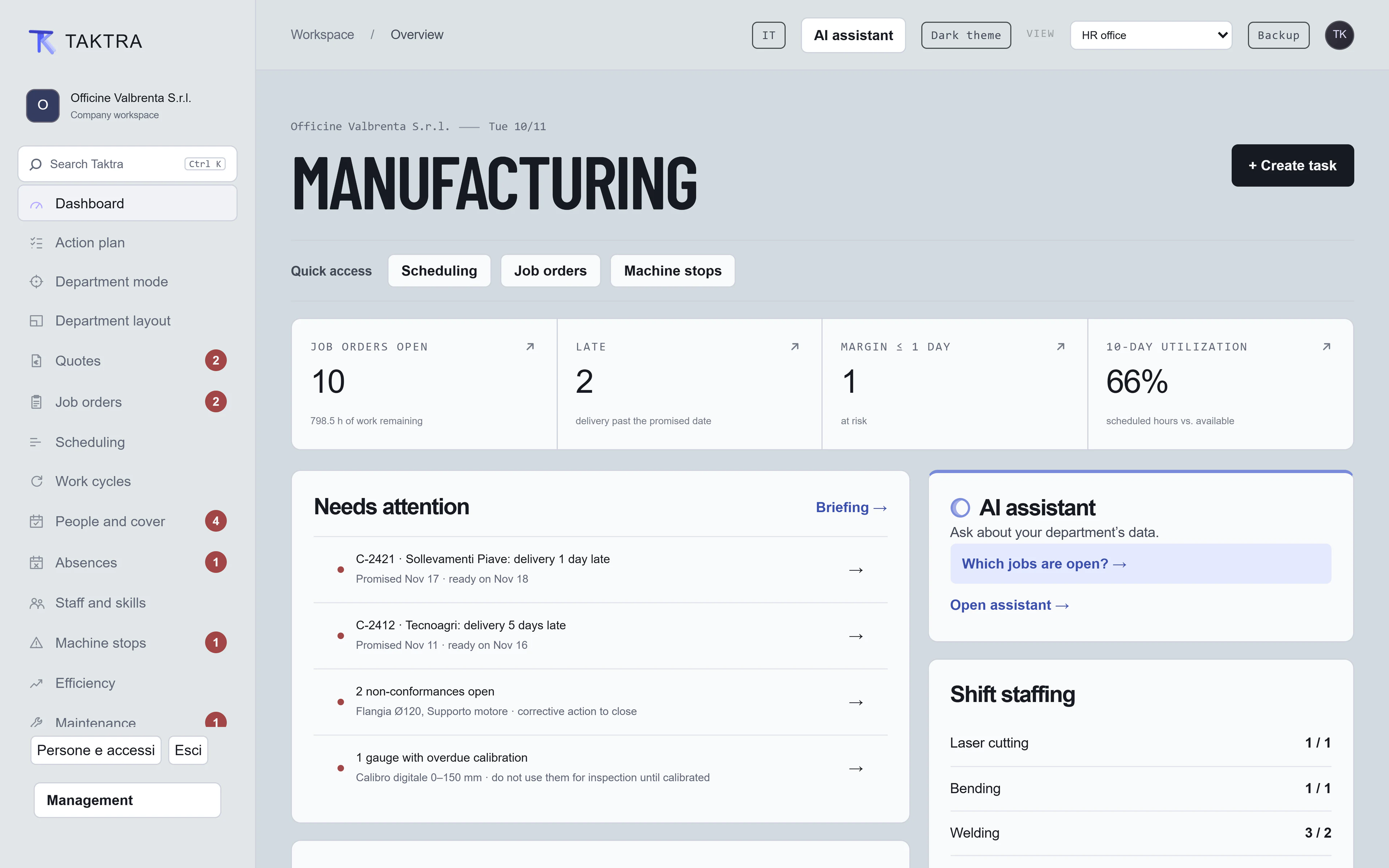
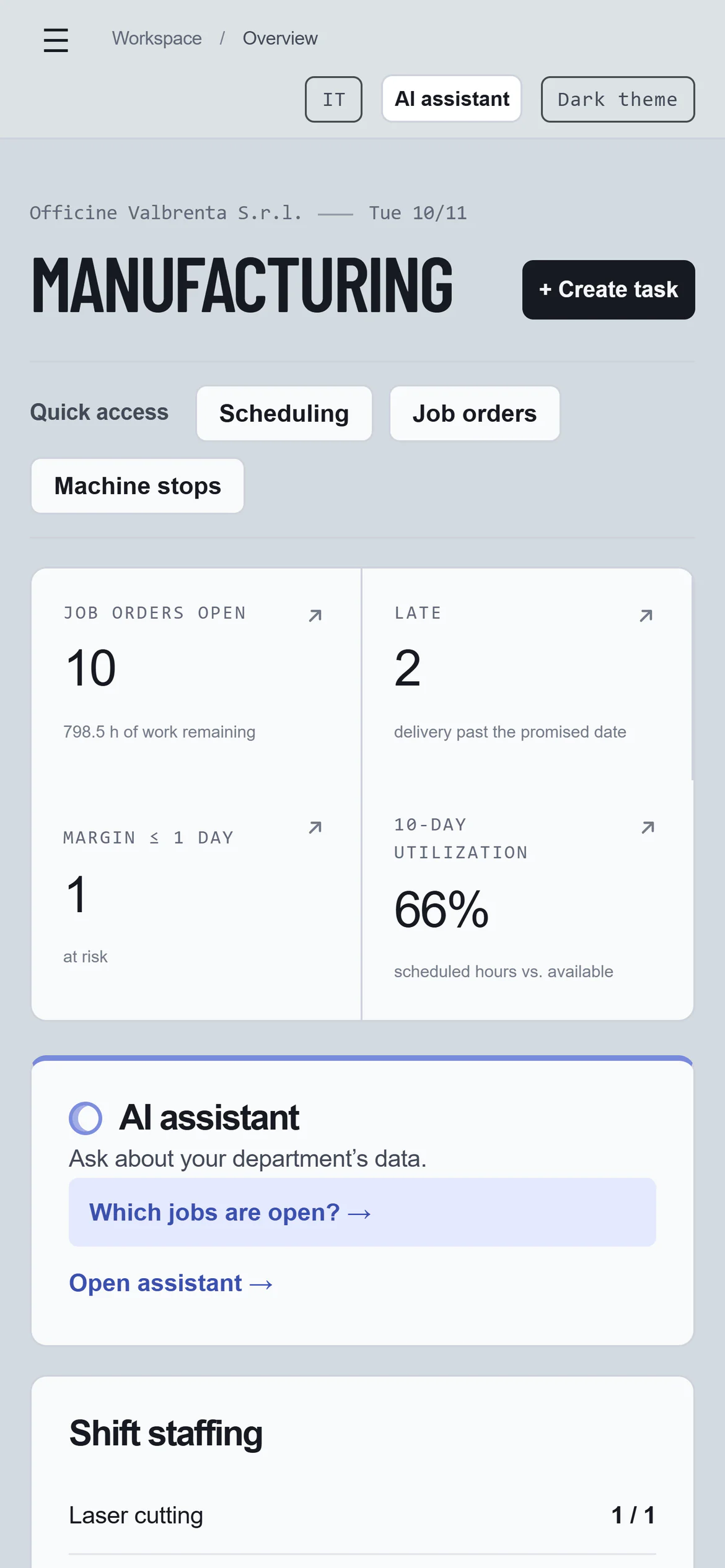
Open jobs with remaining hours, late deliveries, margins under a day and utilisation for the next ten days. Below: “Needs attention”, your next moves and shift staffing by station.
Workshops & manufacturing
Taktra calculates the expected date of every job from today’s real capacity — machines, people, stoppages, maintenance, materials — and recalculates it the moment something changes.
Opens at once with sample data: no sign-up, no card.
Every morning
The dashboard opens with four numbers — open jobs, late, tight margin, ten-day utilisation — and with “Needs attention”: the things that cannot wait.
Real examples from the “Needs attention” list in the sample workspace.
Sound familiar?
Inside the app
Scroll: the screens come apart. Each layer is a piece of the day, and they all read the same data.
20 modules
Every module reads the same data. Record a stoppage or an absence once, and scheduling, job orders and deliveries update themselves.
What is happening, what to do now and how it went.
Open jobs with remaining hours, late deliveries, margins under a day and utilisation for the next ten days. Below: “Needs attention”, your next moves and shift staffing by station.
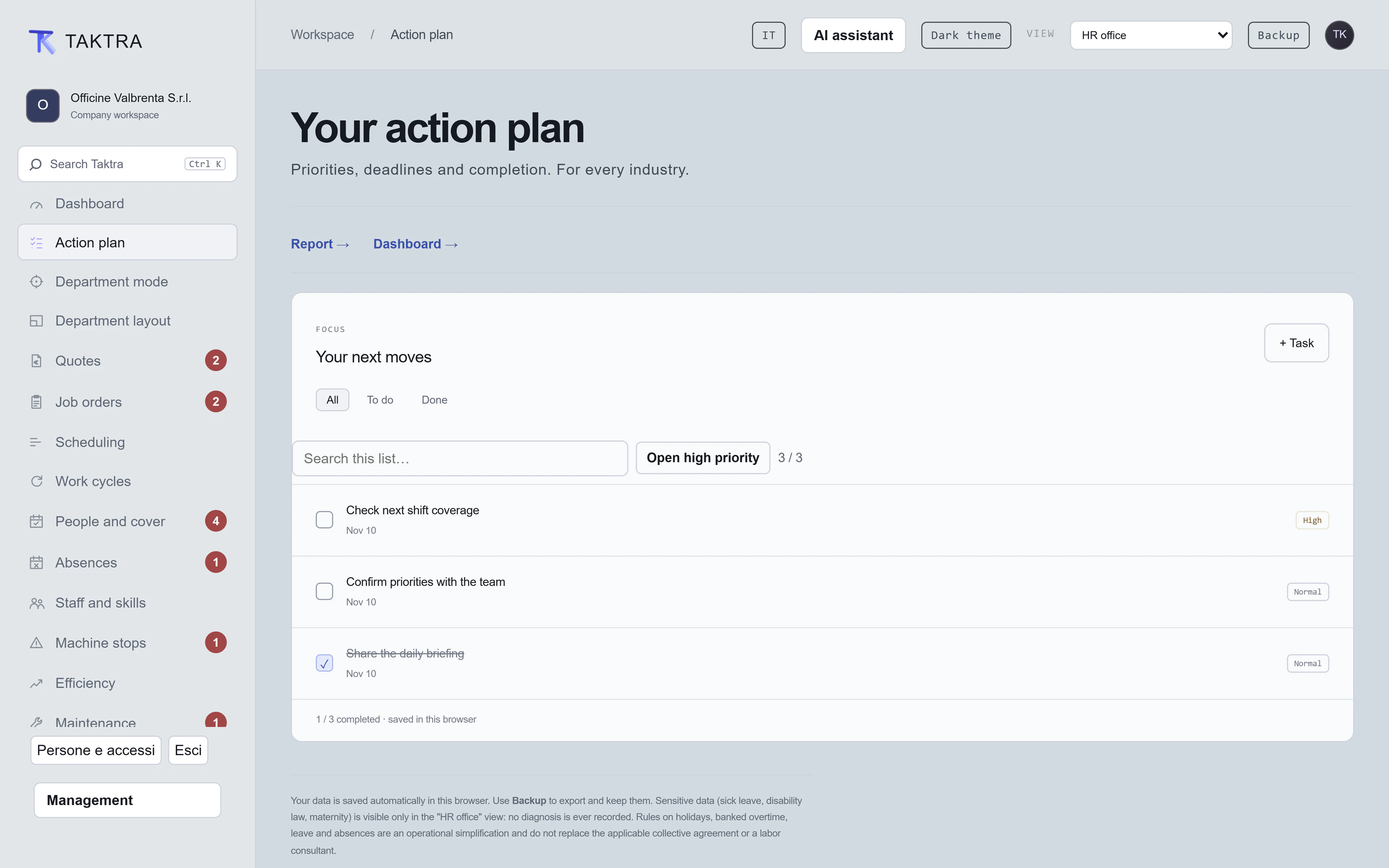
Your next moves with priority and due date. Whoever coordinates knows what to close today.
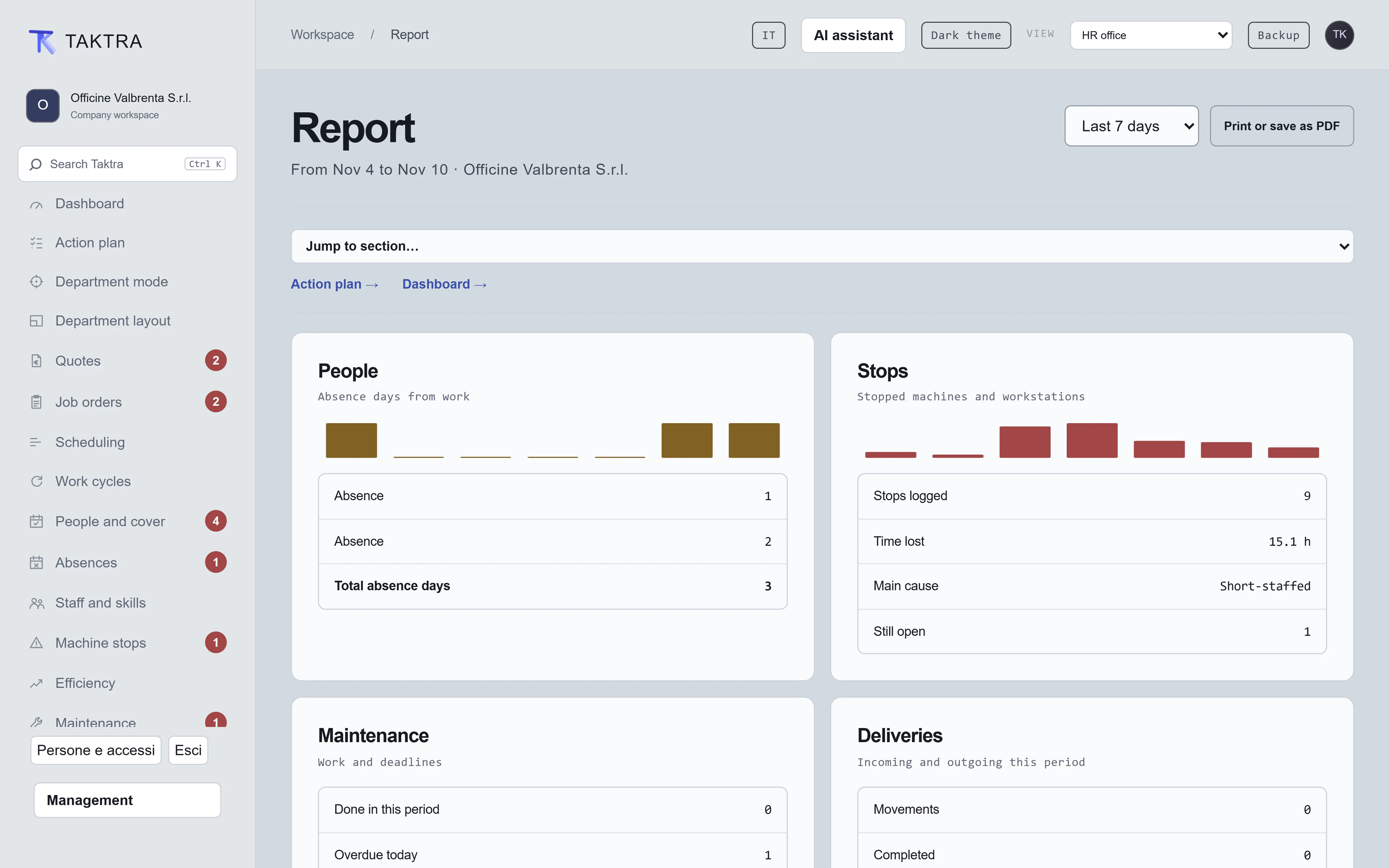
People, stoppages, maintenance, deliveries, orders and quality over the last 7, 30 or 90 days. Print it or save it as PDF.
From the quote down to each operation.
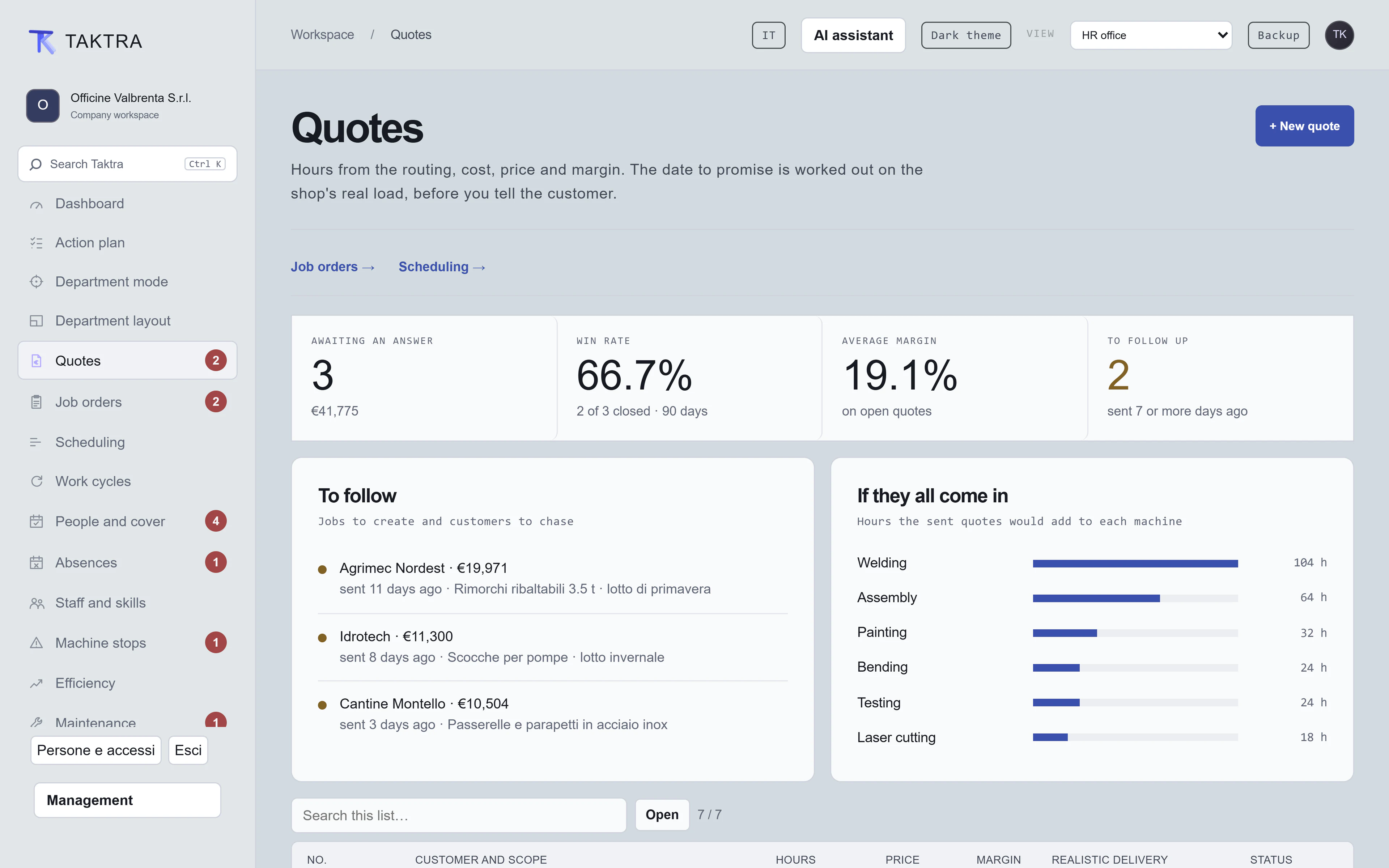
Hours from the routing, cost, price and margin. The date to promise is worked out on the shop’s real load, before you tell the customer. When the customer accepts, the quote becomes a job.
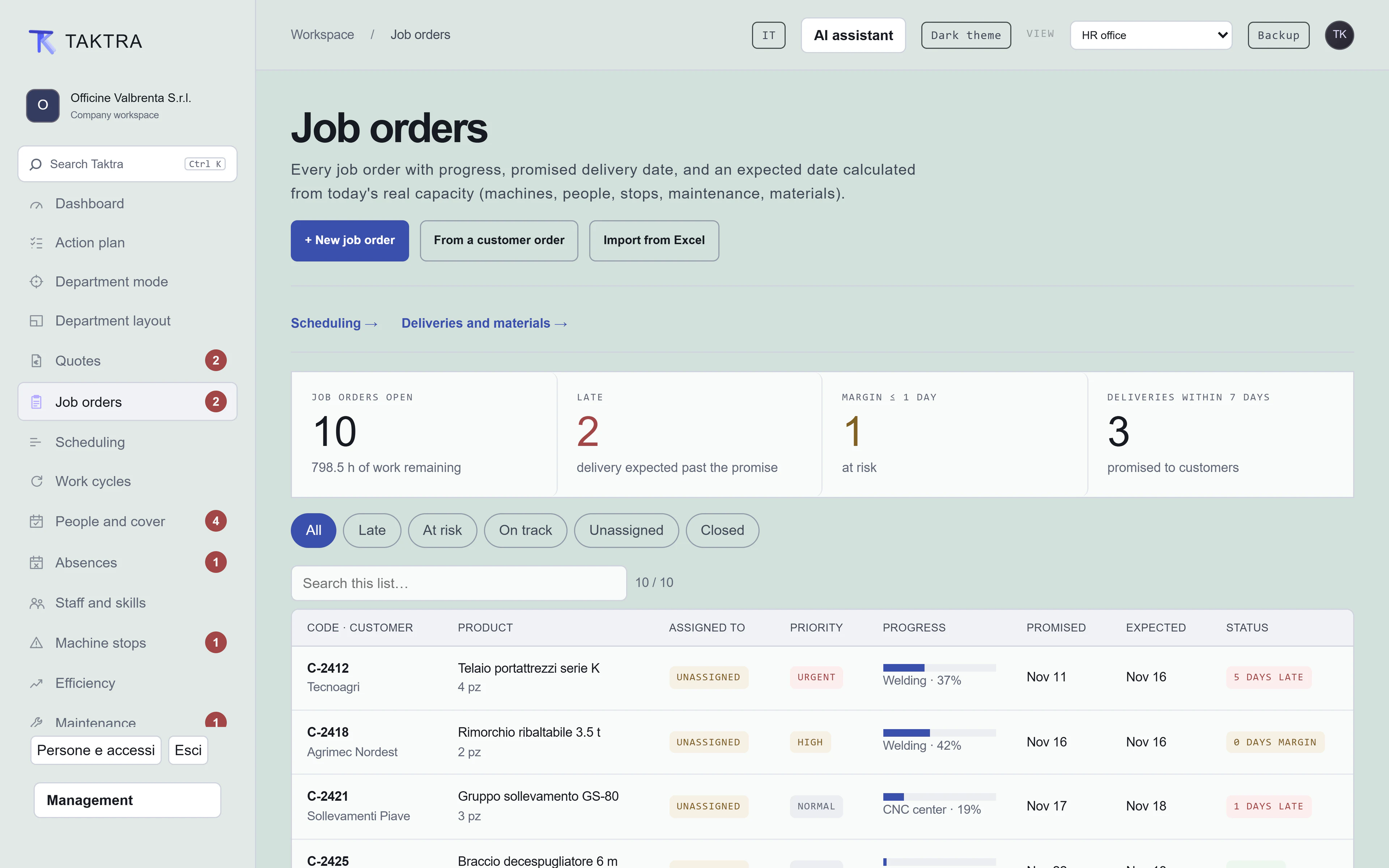
Every job with progress, promised delivery and expected date, calculated from today’s real capacity. With “From a customer order” the AI reads the customer’s PDF, photo or email text and prepares the jobs for you to confirm. Excel import also takes messy sheets: the AI recognises the columns.
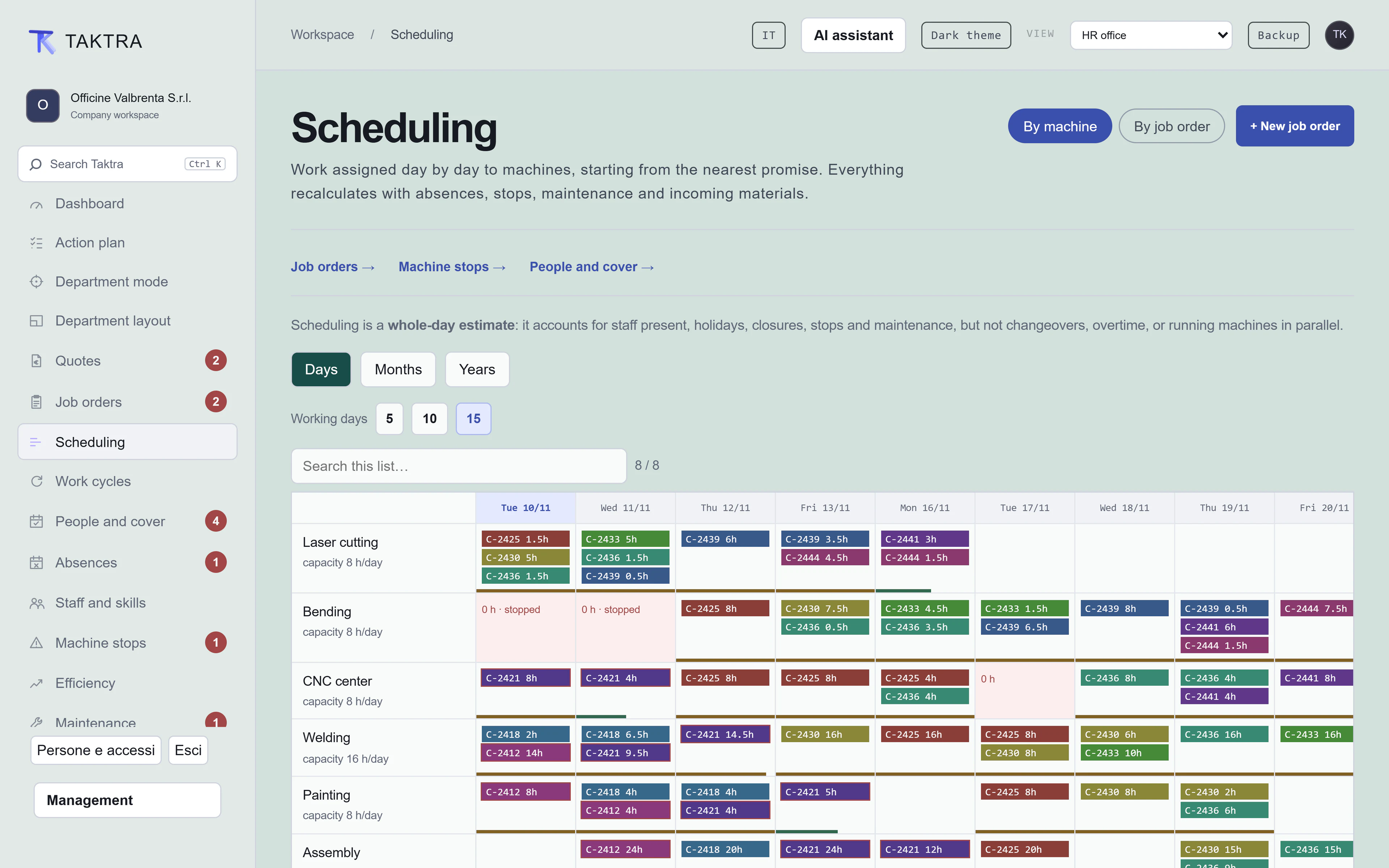
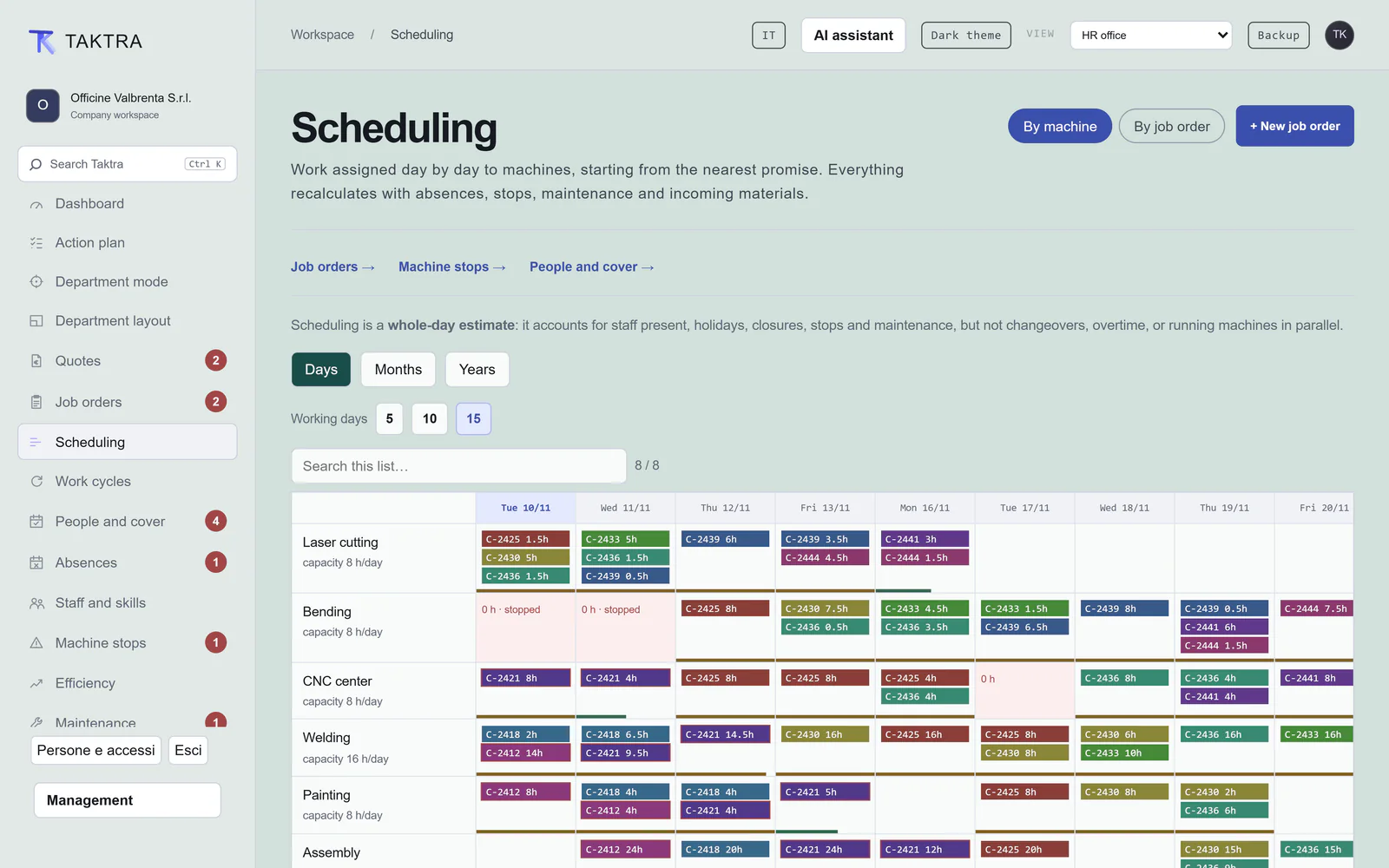
Operations assigned day by day to machines, nearest promise first. View by machine or by job, across days, months or years.
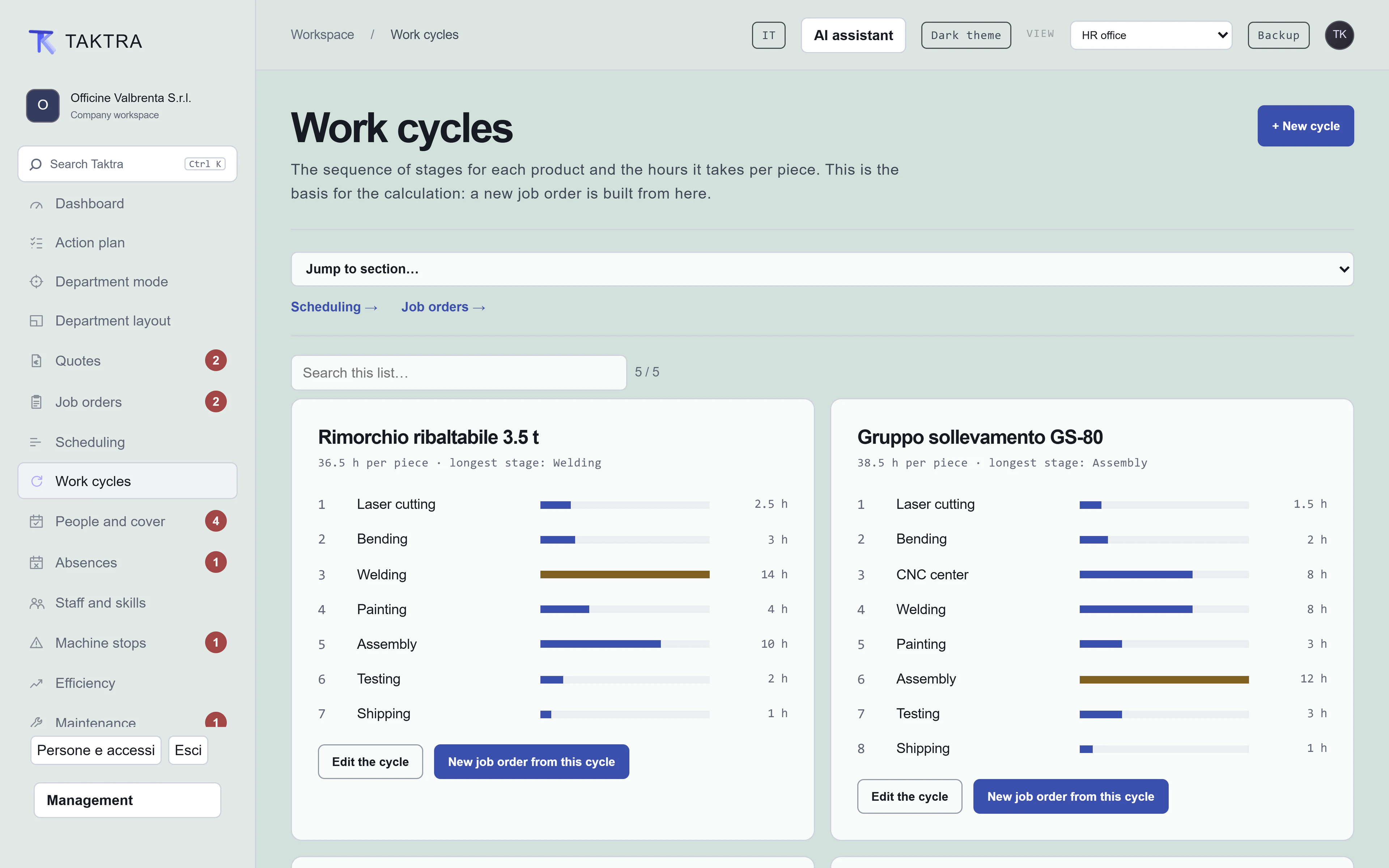
The sequence of stages for each product and the hours per piece. It is the basis of the calculation: a new job starts here.
Who is in, who is off, who can cover.
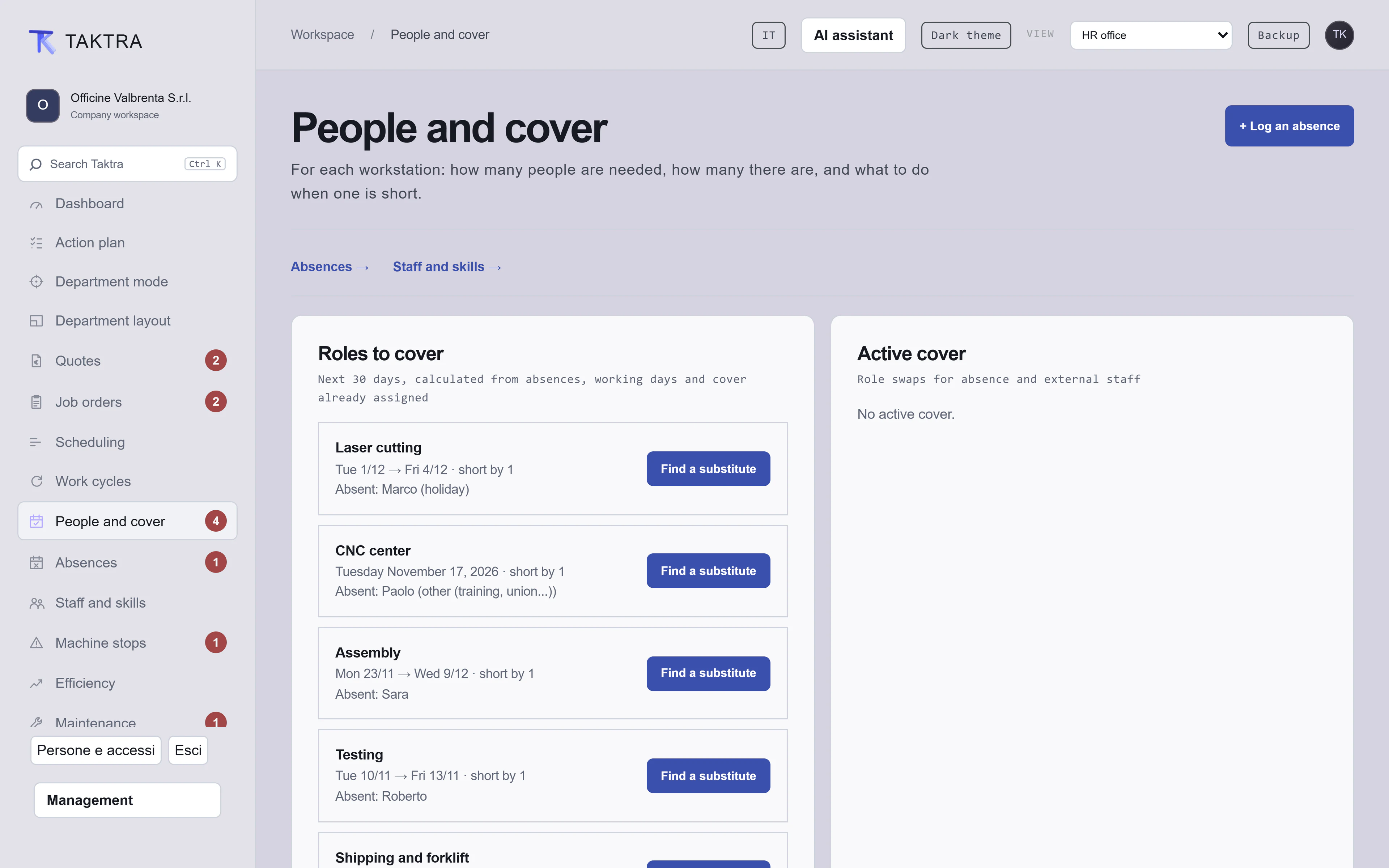
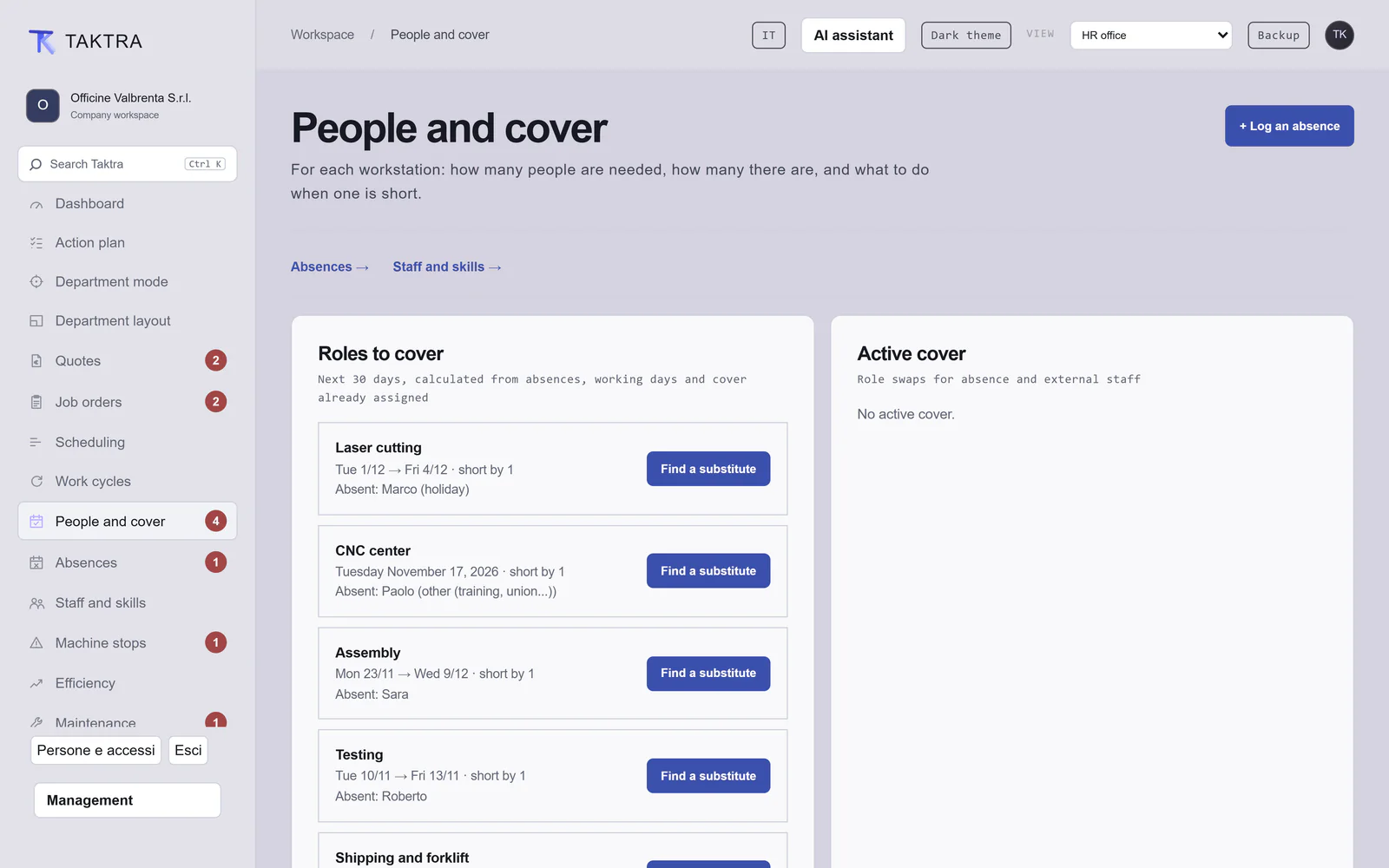
For every position: how many people are needed, how many there are and what to do when one is missing. Gaps over the next 30 days come with a “Find cover” button.
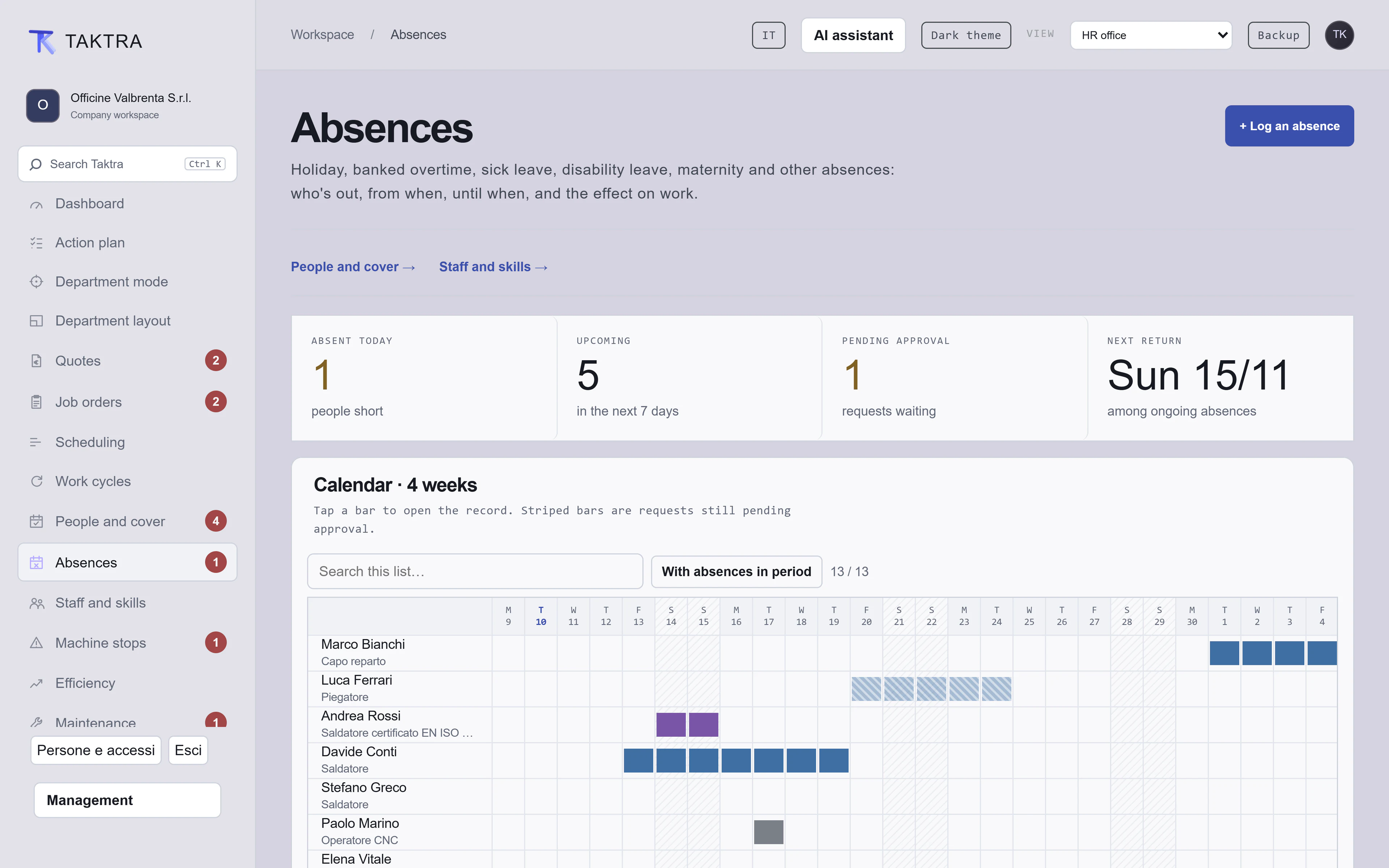
Holidays, leave and other absences on a four-week calendar: who is off, from when, until when. Requests awaiting approval are shown dashed.
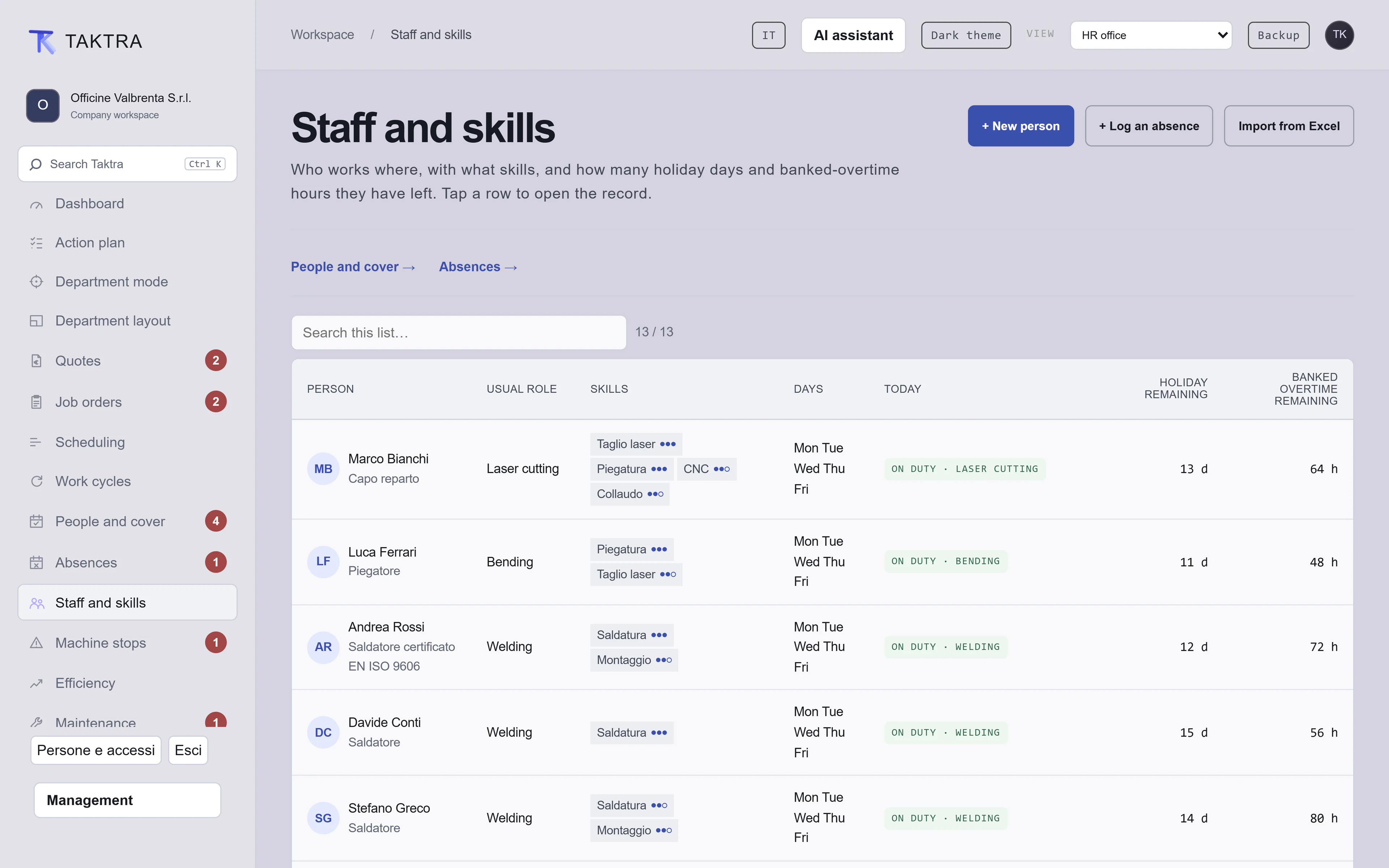
Who works where, with which skills on three levels and how much leave they have left. With a skills matrix and Excel import.
The physical space, and everything that stops it.
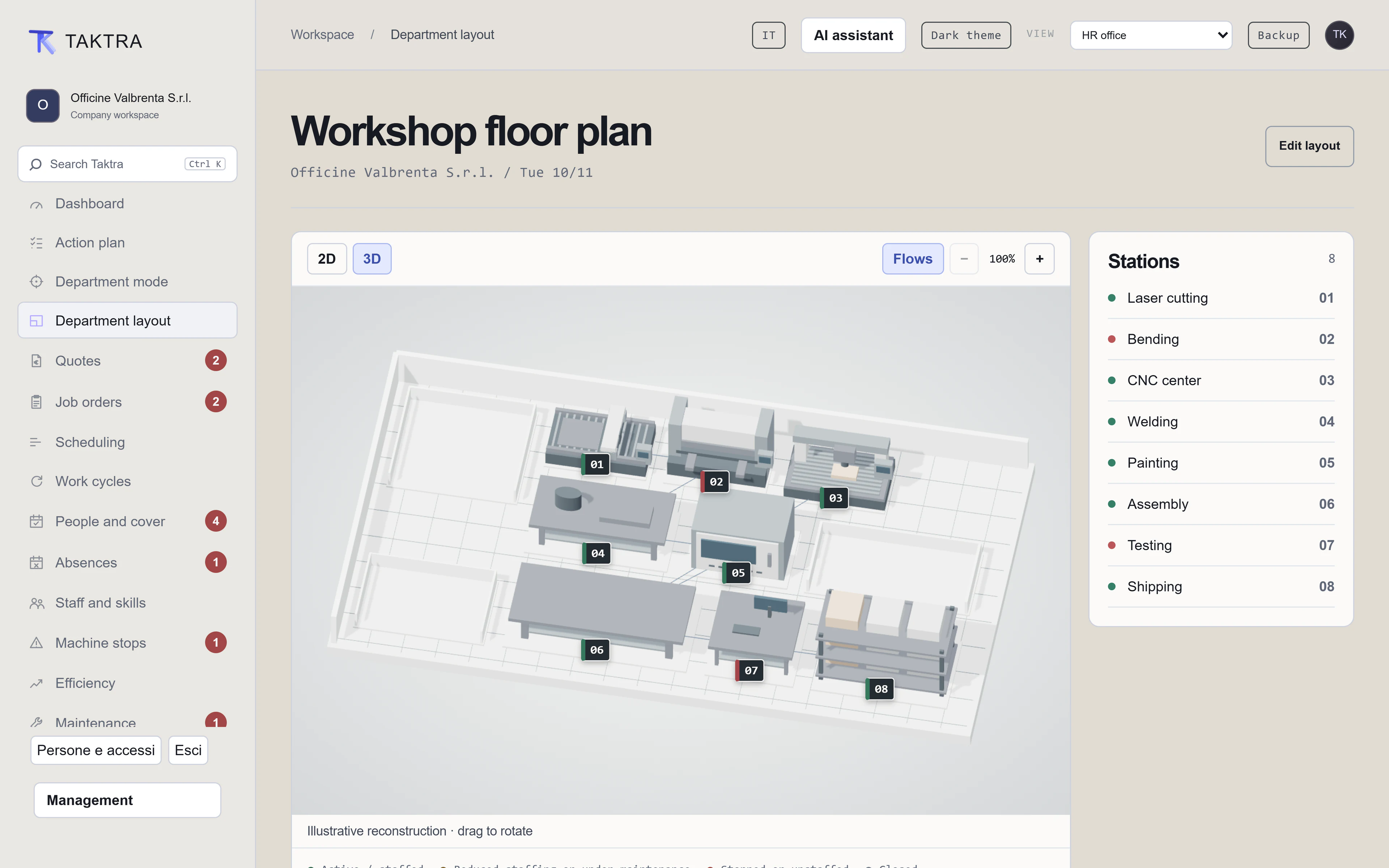
The workshop floor plan in 2D, 3D or by flows. Every station shows whether it is active, under-staffed or in maintenance, stopped, or closed. The layout is editable.
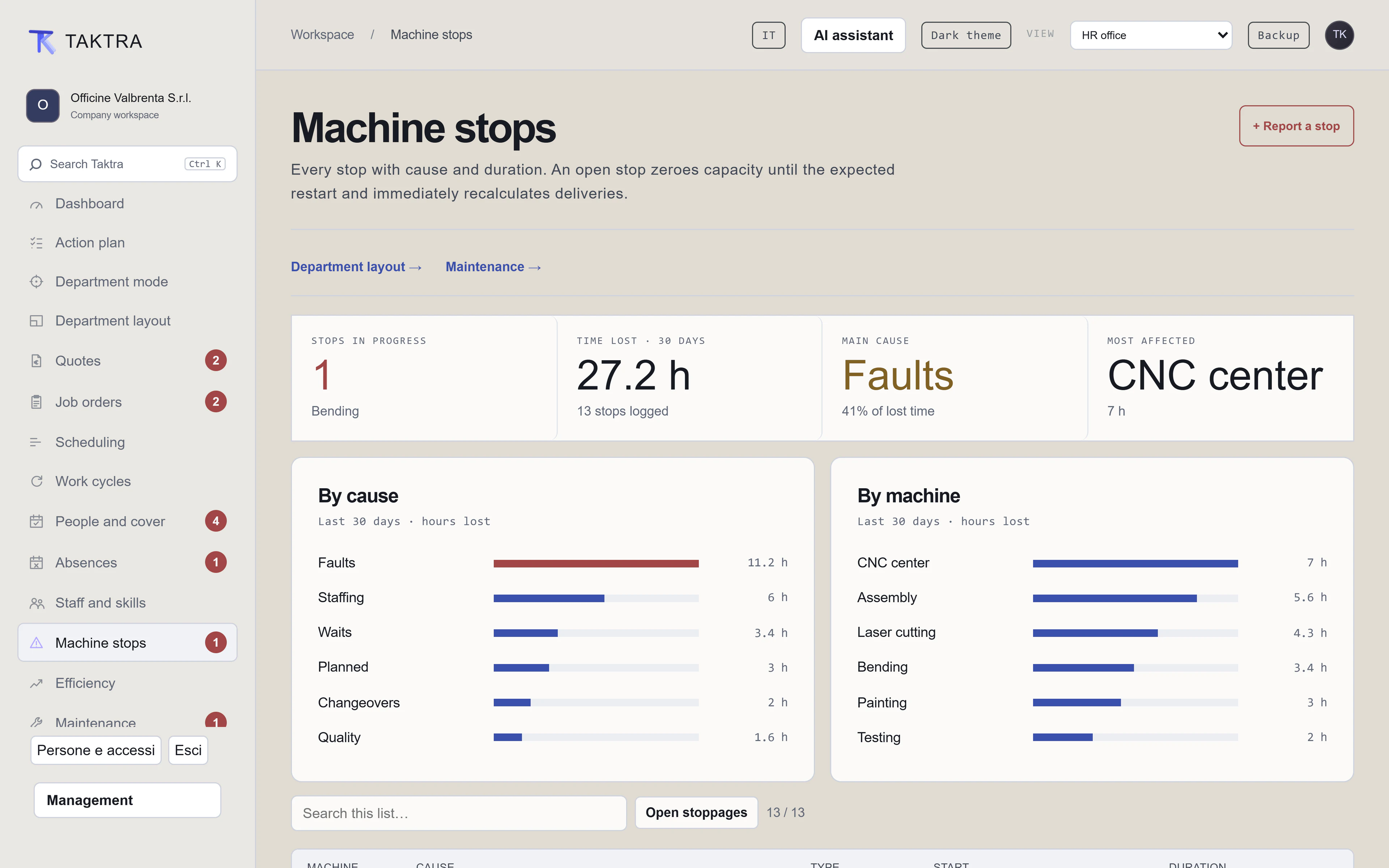
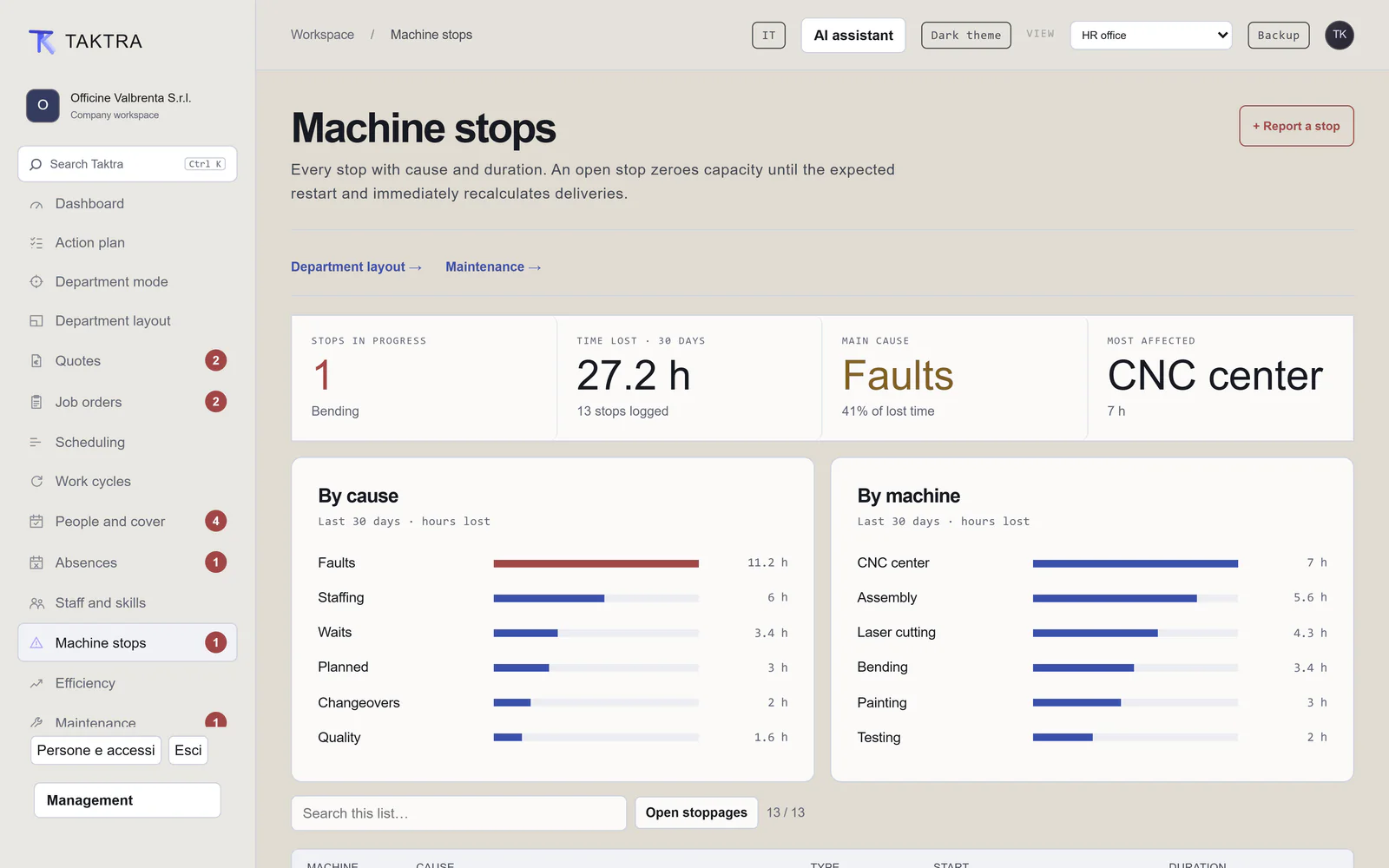
Every stoppage with cause and duration. An open stoppage zeroes capacity until the expected restart and recalculates deliveries at once. Analysis by cause and by machine over the last 30 days.
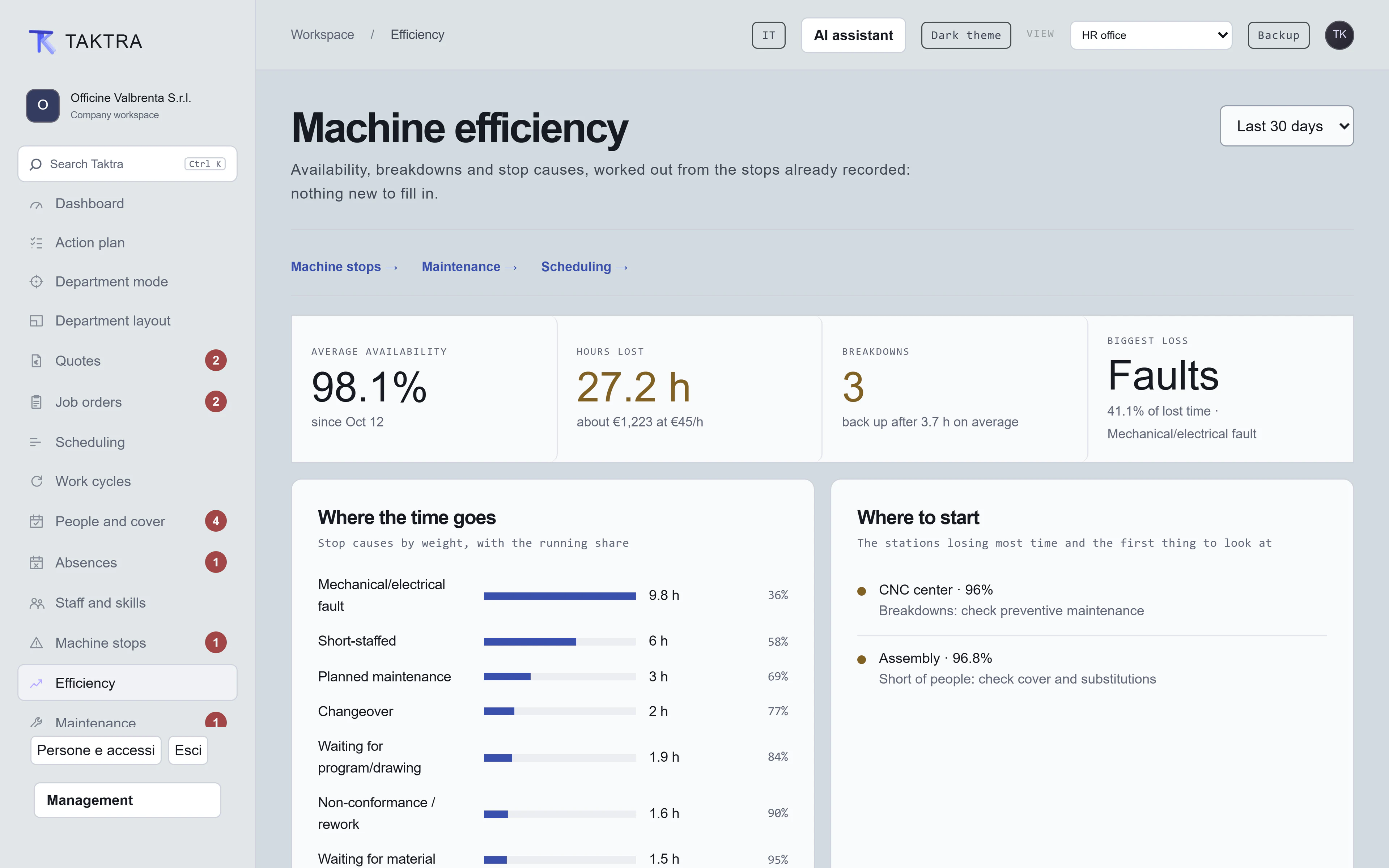
Availability, breakdowns and stop causes for every machine over the last 7, 30 or 90 days, worked out from the stoppages already recorded: nothing new to fill in. Hours lost are also estimated in euros.
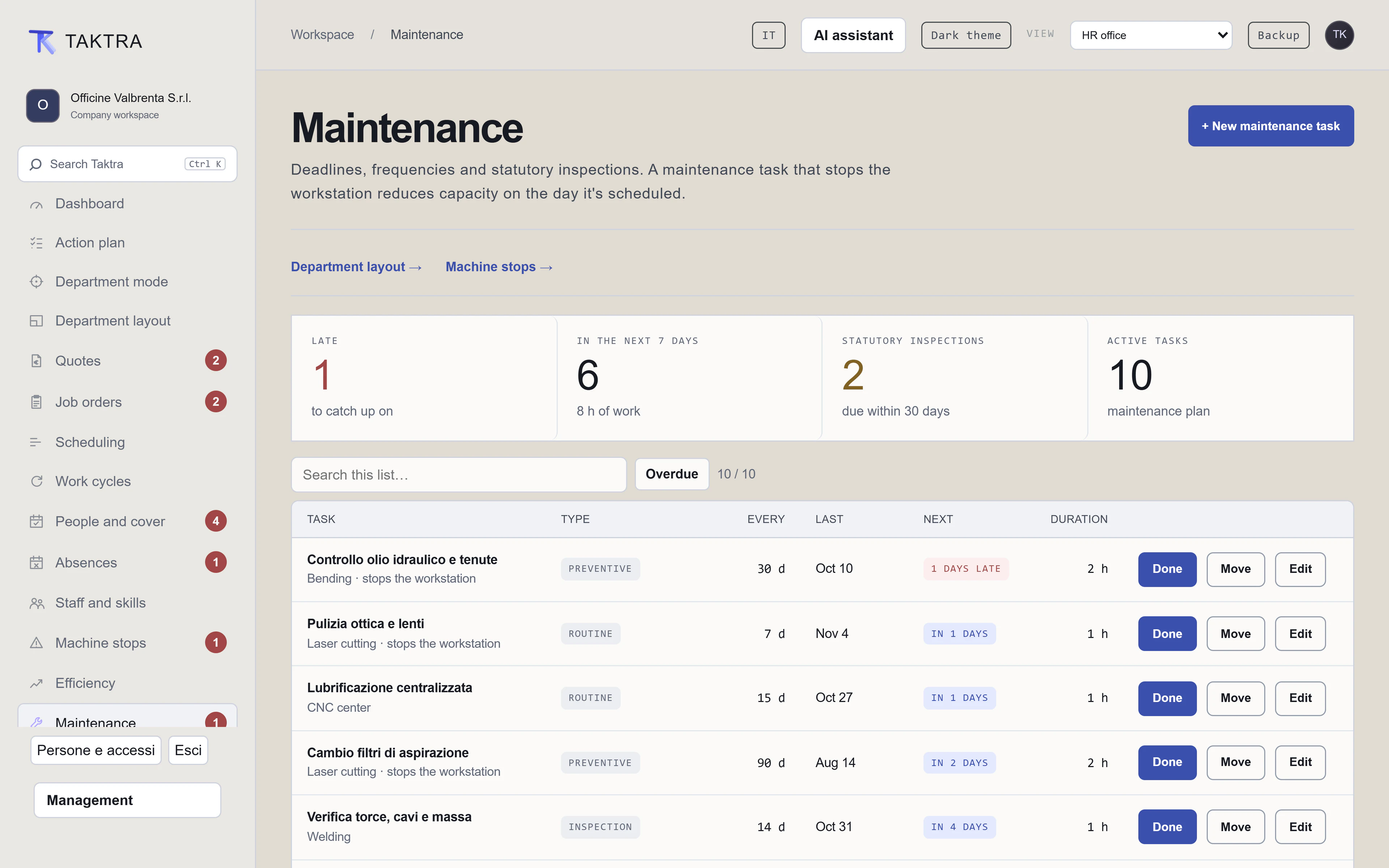
Due dates, frequencies and statutory inspections. Maintenance that stops a station reduces capacity on the day it is scheduled.
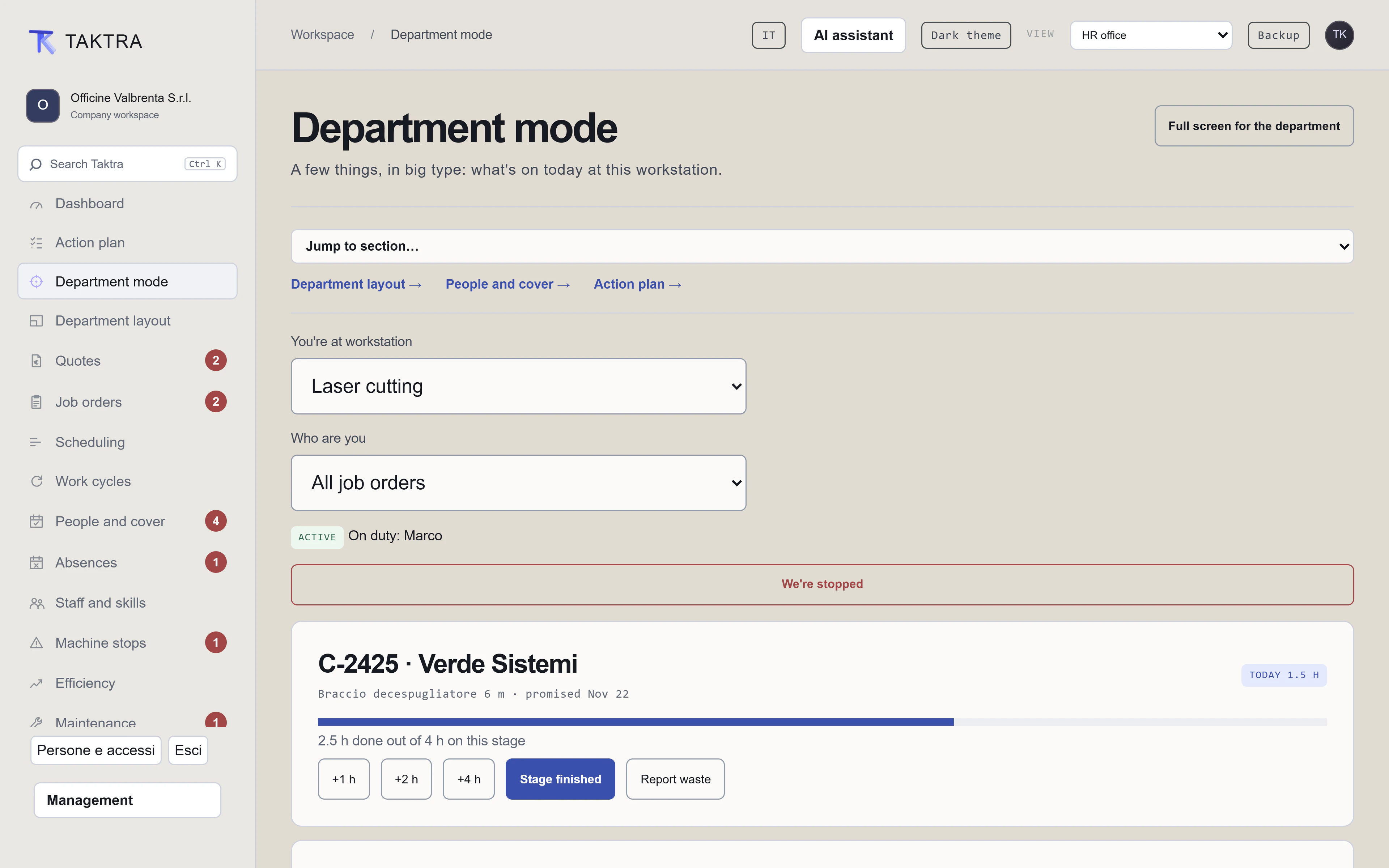
A few things, big: what needs doing today at this station. Full screen, for a tablet or a monitor on the floor.
What comes in, what goes out and what did not go as it should.
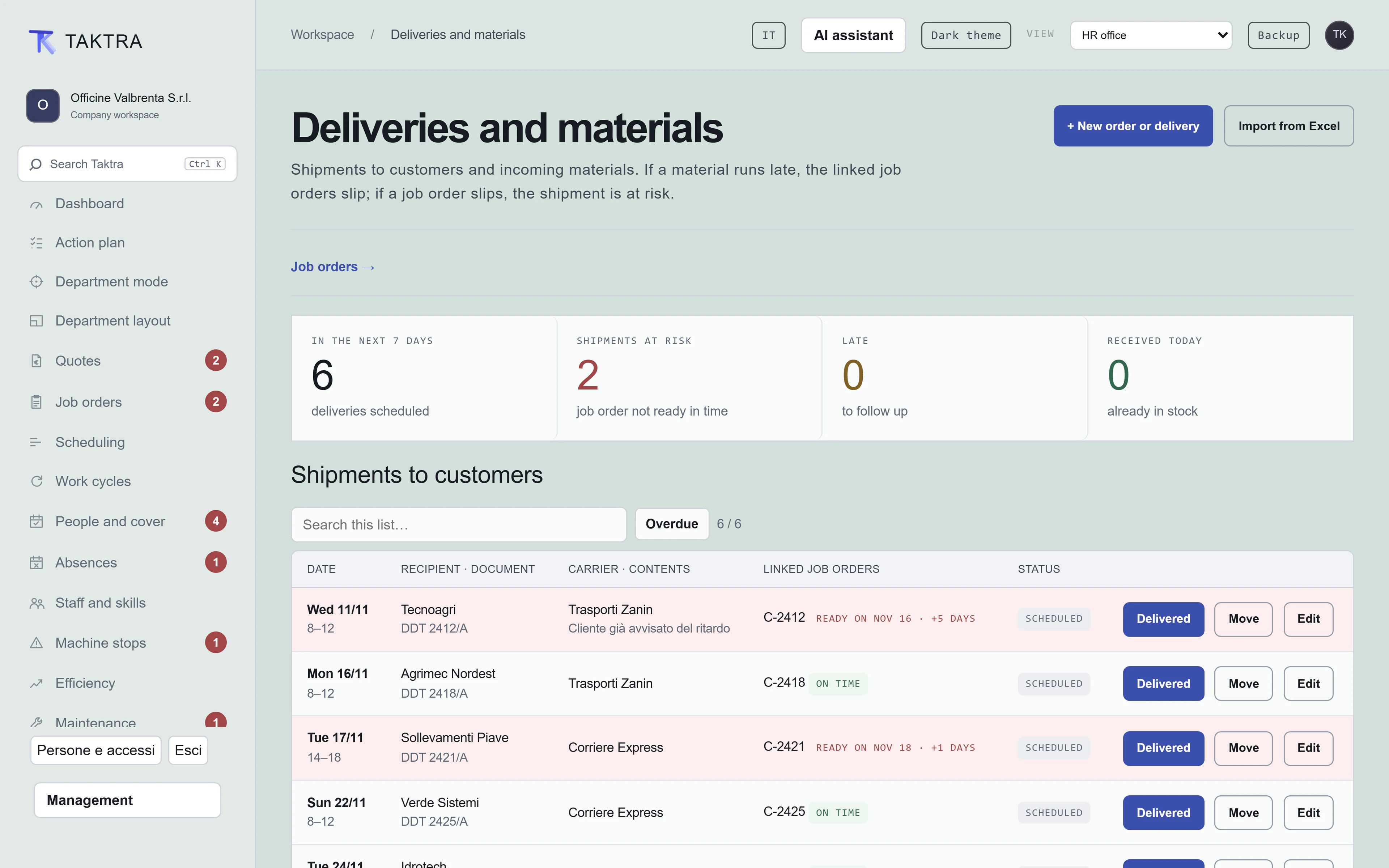
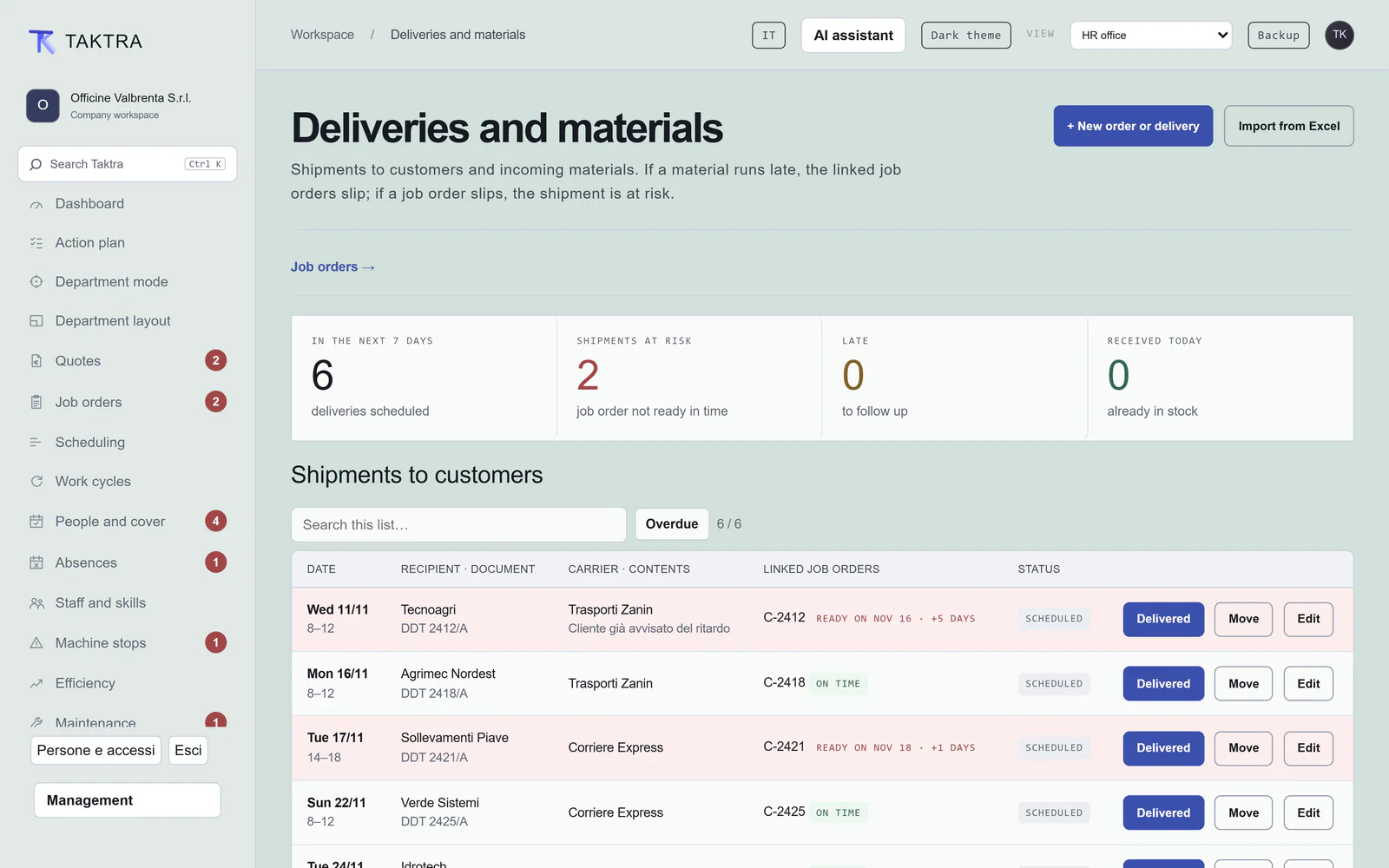
Shipments to customers and incoming materials. If a material is late, the linked jobs slip; if a job slips, the shipment is at risk.
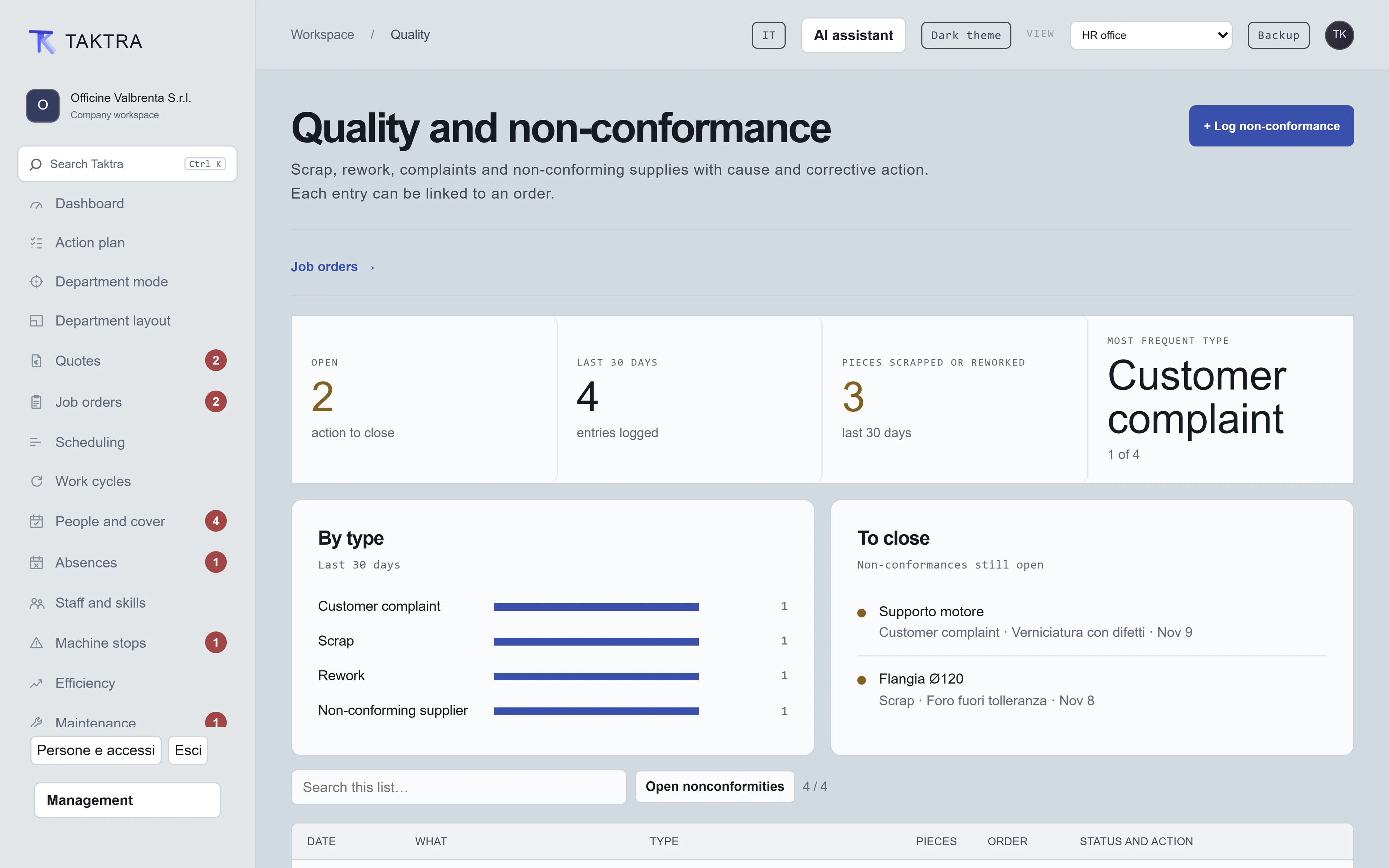
Scrap, rework, complaints and non-conforming supplies, with cause and corrective action. Each entry can be linked to an order.
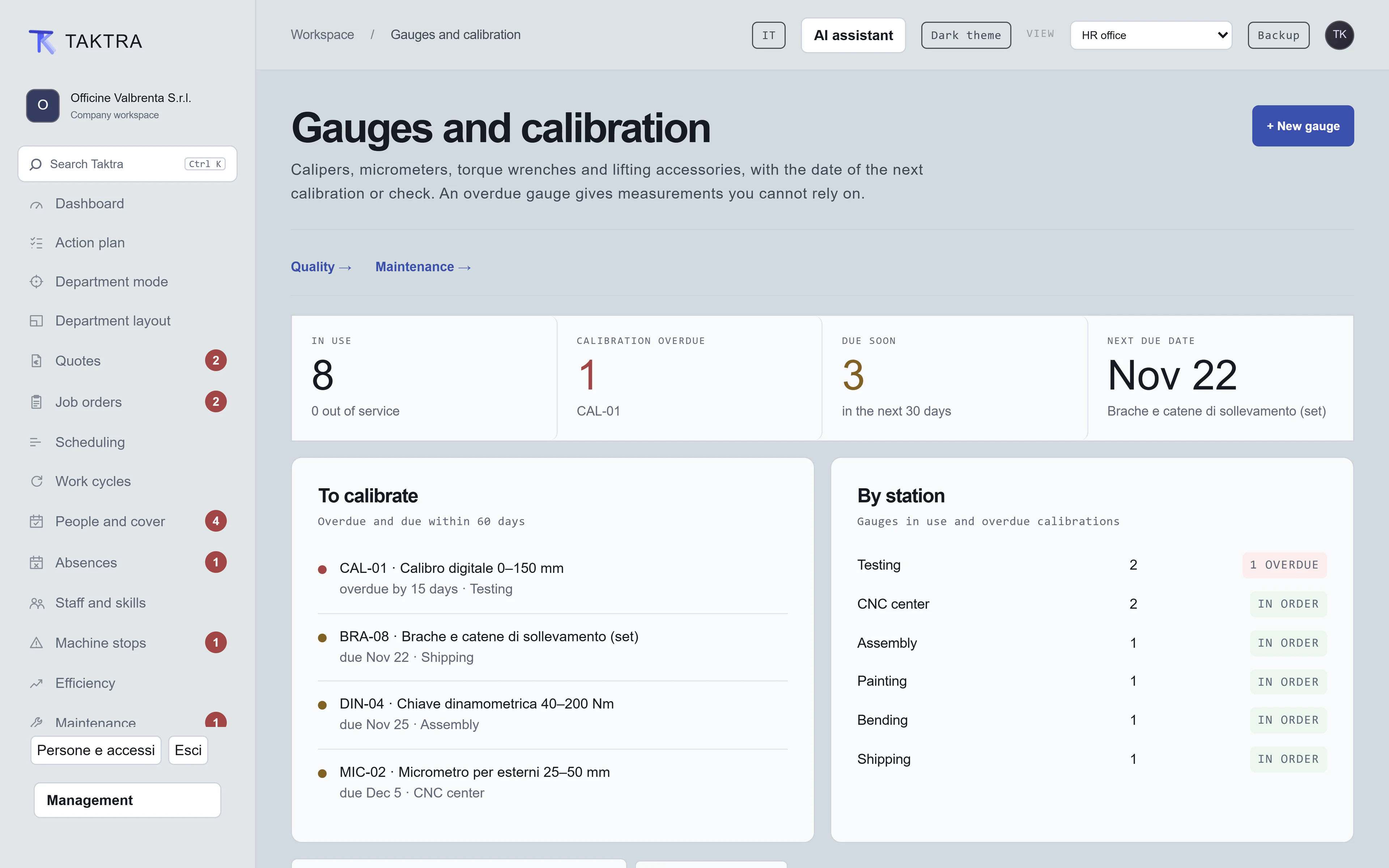
Calipers, micrometers, torque wrenches and lifting accessories, with the date of the next calibration or check. An overdue gauge goes on the list of things to fix.
The workshop described once, used everywhere.
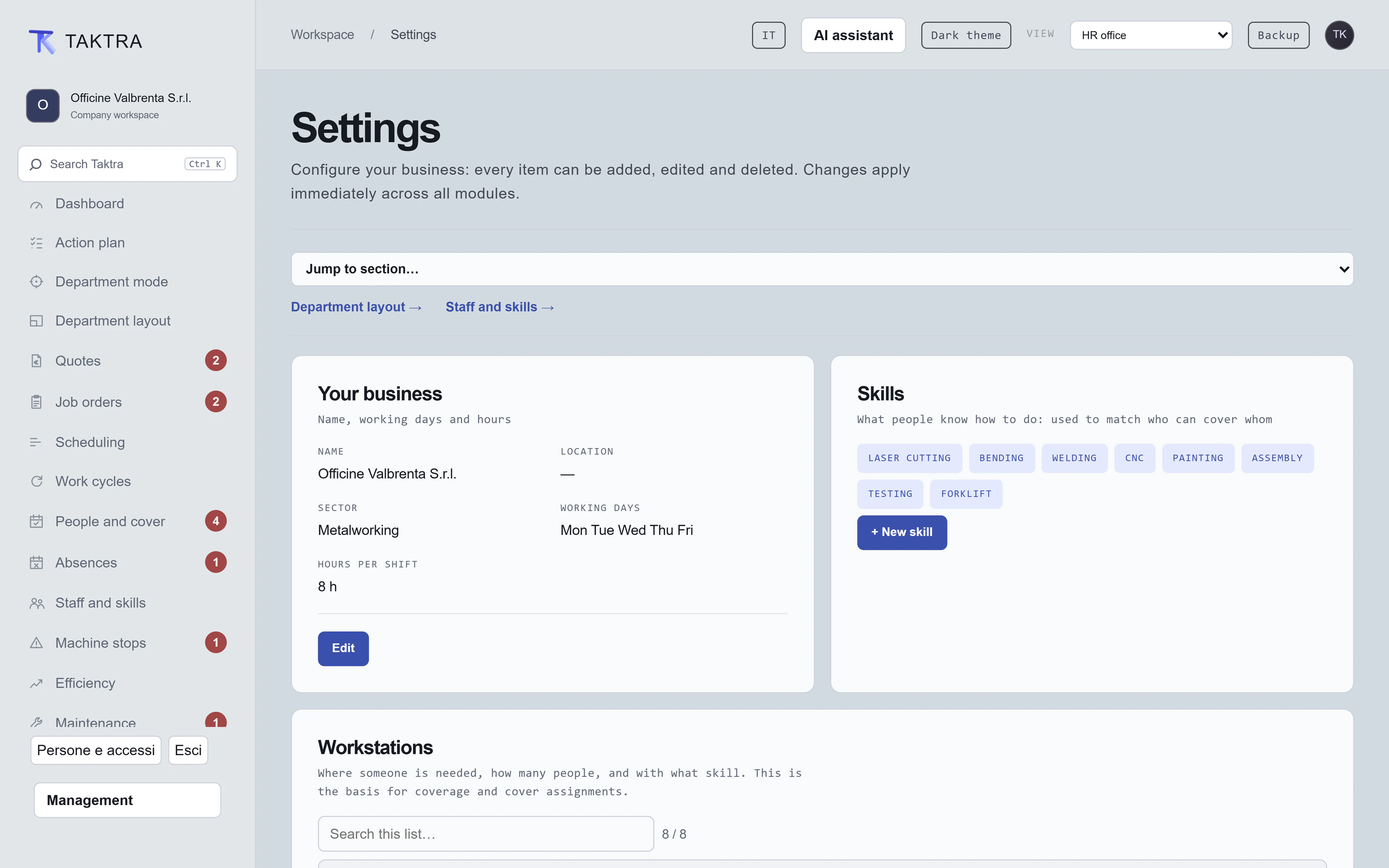
Skills, positions, machines and departments, cycles, calendar and lists: every entry can be added, edited and deleted. You also choose which modules to show and in what order.
Messages between office and floor, available with a Taktra online account.
Tap a screen to view it at full resolution. Screens show the app’s sample workspace.
A day with Taktra
Told with the sample workspace data: Officine Valbrenta, eight stations, thirteen people.
The dashboard says where to look: utilisation for the next ten days is at 66%, but two deliveries are past their promise and one has less than a day of margin.
Hydraulic fault, technician expected tomorrow. The open stoppage zeroes the station’s capacity until the expected restart: deliveries that pass through it recalculate themselves.
“Roles to cover” looks thirty days ahead: on Tuesday the 17th the CNC centre is one short. From there you look for cover among those with the skill.
Operations are reassigned day by day, nearest promise first. You see the load machine by machine and utilisation for the next two weeks.
Every job shows the promise and the expected date. When they differ, you know before the customer does, not after.
Your vocabulary
In a workshop Taktra uses workshop words. In other sectors the same functions change name and screens.
| In general | In Taktra, for workshops | What it is for |
|---|---|---|
| Before the customer says yes | Quotes | Price, margin and a realistic date |
| Work to deliver | Job orders | Progress, promise and expected date |
| The plan | Scheduling | Operations by machine, day by day |
| How a product is made | Work cycles | Stages and hours per piece |
| Who covers positions | People and cover | Gaps and substitutes |
| What stops | Machine stops | Cause, duration, effect on deliveries |
| The space | Department layout | Floor plan in 2D, 3D and flows |
| What comes in and goes out | Deliveries and materials | Shipments and incoming materials |
AI assistant
The assistant queries the floor’s data: jobs, delays, cover, stoppages, deliveries. Write the question the way you would ask a colleague.
Sample question and answer, from the app’s sample data
The assistant answers only with your company’s data. Every proposal is read and confirmed by you. How it works
3D floor plan
It is the floor plan you get in the app: the stations, the state of each one and the flow of work. Drag to turn it and tap a station to see how it stands right now.
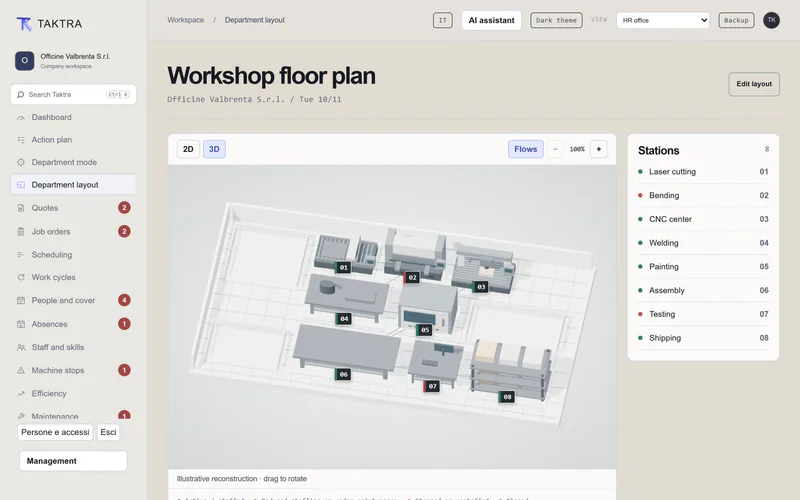
Illustrative reconstruction · drag to rotateApp screen · sample data
On the floor and in your pocket
Department mode shows operators the jobs at their own station, large and without menus. Everything else runs in the browser on computer, tablet and phone.
Frequently asked
Thirty days to see whether your team really uses it. Open Taktra in your browser, create your company and describe how you work.
No card needed to start: 30 days free, then you decide whether to subscribe.
Taktra’s virtual assistant
It answers by voice or in writing and, if you like, takes your details: then a member of our team writes to you. It is an AI, not a person.
When you open it, the conversation goes through ElevenLabs, which handles it on Taktra’s behalf. Privacy notice